Today I Learned — 2026-02-09
Today, I learned a lot. However, I have limited capacity to deep-dive on a daily basis. Perhaps, I should reserve it for a weekly issue? Anyway, still sharing my smattered thoughts, and more importantly, with references.
Table of Contents
- 1. Infographic: What We Know
- 2. Pax-Silica
- 3. KSA-UAE Dynamic
- 4. Grounding Cloud
- 5. Book Recs: History of Statistics
- 6. Project Panama
- 7. Interregnum
1. Infographic: What We Know
I came across a cool infographic that shows the different frontiers of current Science.
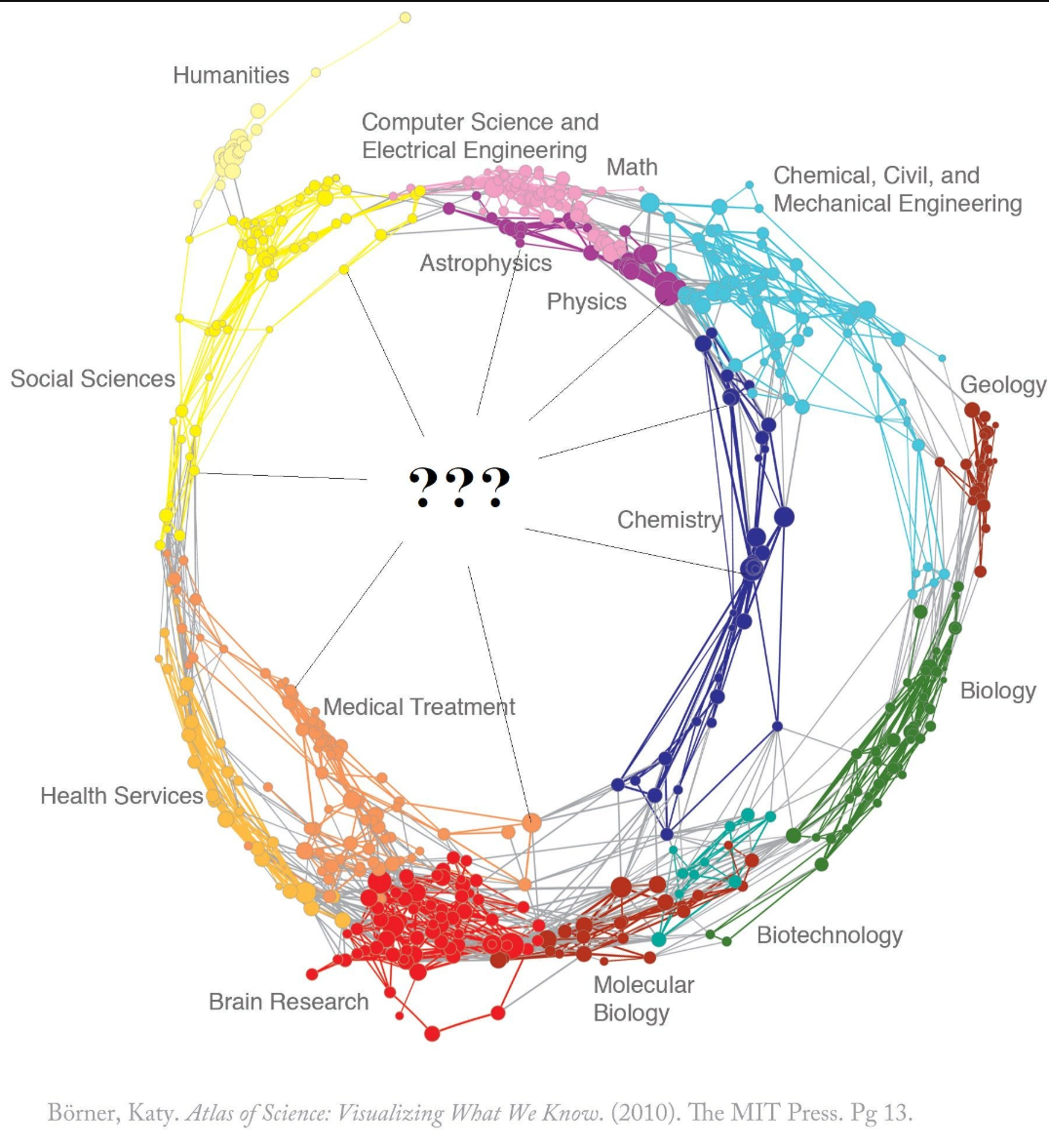
What is the bridge that should unite (or give a framework to) all these disciplines? I'd argue that it is Philosophy, but rooted in Cosmology and Revelation. But, I don't think such a bridge — integrating all of these to a unified whole — exists. Such good visualizations can be a great facilitator for such a project, though. Parts of the book can be accessed here: Atlas of Science: Visualizing What Know.
2. Pax-Silica
USA announced in December 2025 about their new initiative: Pax-Silica. Oil and steel were 20th century focus; now is the time for silica. Or so says the US. As part of this new outlook, the U.S. is out to secure a stable supply chain for the critical raw materials needed to power a Pax-Silica world and counter China. Key partners include the UK, Australia, Greece, South Korea, Singapore, Israel. Qatar and UAE were very recently added, with India set to join by the end of February this year.
This is the official website: Pax-Silica. Here is the news on India joining this initiative: The Economic Times.
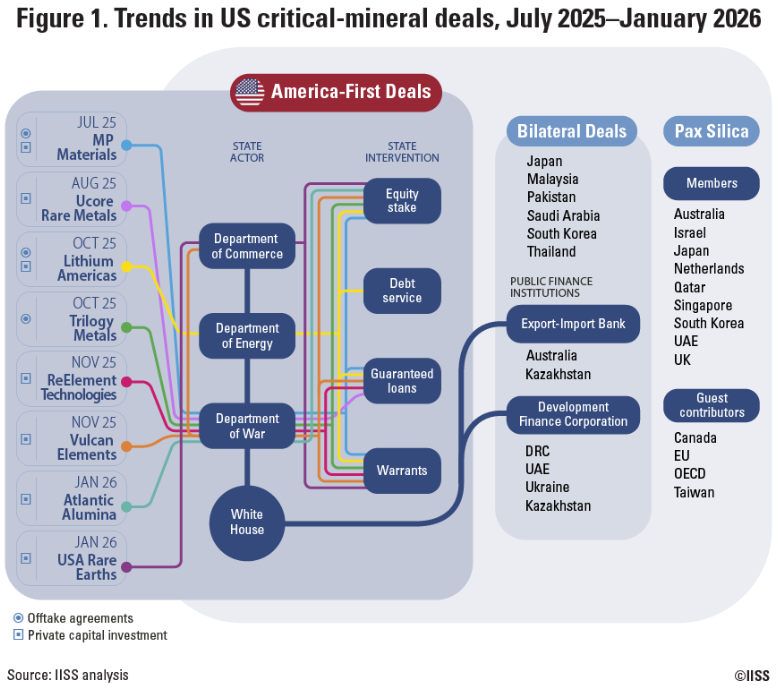
To get a broader perspective on Pax-Silica, Dr. Maria Shagina's analysis is a must read: US critical-minerals diplomacy: from America-First deals to Pax Silica.
Maria situates the US strategy evolvement as follows:
- America-First Deals: Increase domestic mineral production. Deeper state intervention in domestic projects. Instead of grants and loans, it increasingly relies on the following state-capital tools:
- Buying stakes in private companies;
- Underwriting long-term demand through offtake agreements; and
- Introducing price floors to stabilize investment incentives
- Bilateral Deals: Expand supply chain and access to critical minerals. Key partners include Australia, Ukraine, Democratic Republic of Congo (DRC), Japan, Malaysia, Thailand, Pakistan, and Saudi Arabia. These deals are marked by state intervention and private capital. State interventions include sovereign wealth funds, government-backed equity, and public-finance guarantees.
- Pax-Silica: As discussed above. It also reflects a recognition that domestic build-out alone cannot solve the security problem, while bilateral deals can be fragmented and slow to scale.
An infographic from the article is worth posting here:
Also, watch out for the US vs China on securing African minerals: US challenges Chinese control in race for African minerals.
3. KSA-UAE Dynamic
The KSA-UAE dynamic more recently has come under scrutiny, with wider implications for the Gulf region. The spat between the two over differing approach to Yemen ended with Saudi obliterating UAE-backed Southern Transitional Council in a matter of days. Hellyer, in a recent article, analyzed the differences between the two as de-escalatory developmentalism vs pre-emptive activism.
He says that Saudi's approach is to reduce conflict in the region and focus more on domestic transformation. UAE, on the other hand, wants to proactively reshape the region as it considers the current order to be brittle. This may not just be confined to Yemen; recently, Somalia backed out of UAE agreements and chose to align closer with Saudi.
This is an interesting dynamic, and one that can have enduring consequences for the Gulf region. Here is the original article: Risk, Order, and Power: The Saudi-Emirati Divergence .
4. Grounding Cloud
It is easy to think of cloud as visceral, something that just exists "out there." However, this is far from true: the world of cloud is extremely concrete and material.
A great visualization project that maps out the cloud concretely is this one by Ali Fard and his team: grounding.cloud. The team categorizes the cloud into four constituents:
- Farms: Large-scale data centers and associated energy projects
- Pipes: Physical networks of delivery and control of data
- Mines: Extractive sites and operations of data
- Enclaves: Corporate headquarters of tech companies and bounded "smart" city initiatives
I won't replicate the details here, but the information on this website is worth reading. Ali Fard also has a book on this: Ground the Cloud — Urbanism in the Shadow of Data. I am going to consider reading this.
5. Book Recs: History of Statistics
Based on my last note, 2026-02-08, I've suddenly grown an interest in understanding how the language of statistics has become so important in our world today. Based on some searching, I found four books on this topic that I'd like to read later:
- The Taming of Chance by Ian Hacking: Goodreads
- Revolutionary Mathematics: Artificial Intelligence, Statistics, and the Logic of Capitalism by Justin Joque: Goodreads
- Beyond Measure: The Hidden History of Measurement from Cubits to Quantum Constants by James Vincent: Goodreads (optional)
- The Empire of Chance: How Probability Changed Science and Everyday Life: Goodreads
6. Project Panama
Elsewhere, AI companies, concerned about having mined all the tokens that exist on the Internet, have turned to mining physical books. Under the auspicious project called Project Panama, Anthropic recently spent tens of millions of dollars to get used books.
They used a 'hydraulic powered cutting machine' to 'neatly cut' millions of books, and then scanned the pages 'on high speed, high quality, production level scanners'.
Full article accessible here: Anthropic didn’t want us to know that they were destroying millions of books to feed their software.
7. Interregnum
We are in the Interregnum — between a slowly dying Liberal International Order (LIO) and a rapidly rising China in a multi-polar world. How do we analyze this phase? Milan Babic suggests we turn to a Gramscian framework — processuality, organicity, and morbidity — for a systemic analyze of our current world.
- Processuality: Instead of framing crises as static 'events', understand it as 'processes'. These 'processes' have a history and are rather long lasting (even up to decades). This is applied at the global economic level.
- Organicity: Distinct from a 'Conjunctural' crisis — those that appear in daily political life, not system-changing — an 'Organic' crisis challenges the very fundamentals on which social orders are built. They product 'morbid symptoms' that disrupt everyday political and economic life and, in the long run, destroy old societal orders and power relations. They are fundamentally rooted in alienation of the masses from their political representation: a mismatch between 'represented and representatives'. This is applied at the state level.
- Morbidity: This is related to what Gramsci described as 'morbid symptoms': "The crisis consists precisely in the fact that the old is dying and the new cannot be born; in this interregnum a great variety of morbid symptoms appear."
This may all sound too theoretical; I recommend reading the full article where Babic maps this framework to some concrete empirical points: Interregnum: Gramsci and the crisis of the liberal world order.